What Happened
This one is hard to write.
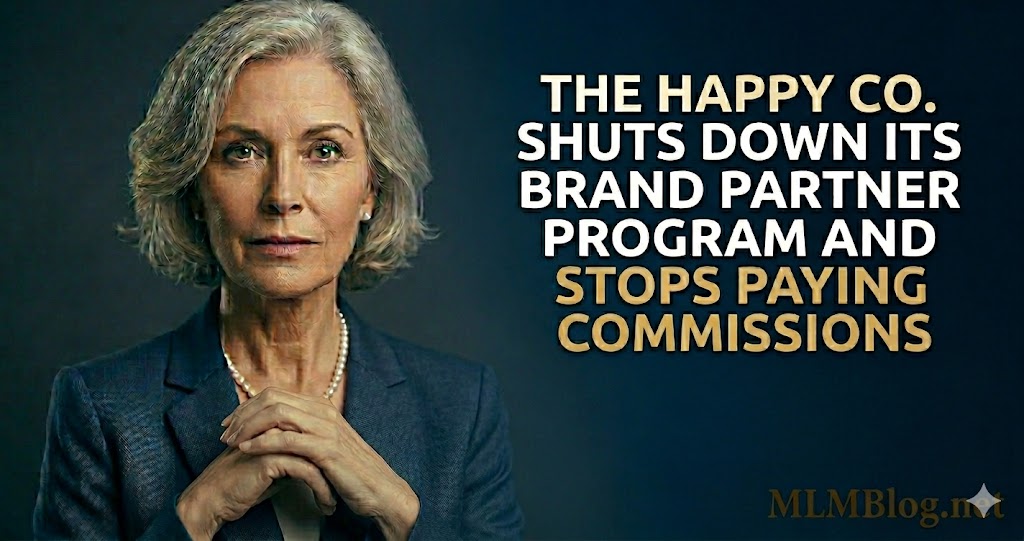
On March 20, 2026, The Happy Co. CEO John “JT” Thatch sent a letter to the company’s Brand Partners informing them that, effective immediately, all Brand Partner activities are suspended and the company will no longer be paying commissions on any future orders.
The letter, which was shared widely on social media by Brand Partners within hours of receiving it, reads in part:
“At this time, we want to inform you that, effective immediately, we are suspending all Brand Partner activities and will no longer be supporting this function of the business as we evaluate our overall business strategy.”
“We will not be paying commissions on any future orders.”
A 20% product discount coupon was offered to current Brand Partners as a parting gesture.
The company says it will continue to sell and ship existing inventory to customers but will not be supporting or compensating its field in any capacity going forward.
The Human Side of This
Before we get into the business analysis, I want to acknowledge something.
There are real people behind this story. Brand Partners who spent years building their businesses, recruiting their teams, standing by this company through what the letter itself describes as “out-of-stock products, logistics issues, and commission disruptions” that had already been going on for months.
One top field leader posted on social media: “This chapter has been so rough, just watching your business, your people — everything you’ve built crumble around you, due to actions and decisions you didn’t make.”
That’s the honest reality of what happens when a direct selling company fails its field. The people at the top make decisions. The people in the field bear the consequences.
If you are a Happy Co. Brand Partner reading this right now, I’m sorry. Your effort was real. The relationships you built were real. None of what happened is a reflection of your work ethic or your character.
The Background
The Happy Co., known for its nootropic and functional beverage products, operates as a subsidiary of Sharing Services Global Corporation, which itself is a subsidiary of DSS Inc., a publicly traded holding company on the NYSE. The corporate structure is complicated, with multiple subsidiaries across wellness, travel, and other categories under the same umbrella.
That complexity is worth noting because in direct selling, corporate structure matters. When the parent company has multiple businesses pulling resources in multiple directions, the field often ends up last in line when things get difficult. And by the CEO’s own admission in the letter, things had been difficult for some time.
The letter acknowledges out-of-stock products, logistics problems, and commission disruptions. These aren’t new issues. Multiple sources indicate these problems had been building for months before today’s announcement.
What This Means for the Industry
The Happy Co. is the latest in a string of direct selling companies that have exited the network marketing model or shut down entirely over the past two years. Beachbody, Modere, Rodan and Fields, Seint, Colored Street, Epicure and others have all made similar exits or closures.
Every one of these situations leaves a trail of brand partners who have to pick up the pieces.
And every one of these situations reinforces the same lesson that I keep coming back to in this space: the stability of your business is ultimately tied to the stability and integrity of the company behind it.
That’s not a comfortable truth. But it’s the truth.
The Question You Should Be Asking
I’m not writing this to scare you or to suggest you should abandon your company tomorrow.
But I do think situations like this one are worth using as a prompt for an honest conversation with yourself about the company you’re building in.
A few things worth evaluating:
Is your company profitable and financially transparent? Publicly traded companies like USANA, Nature’s Sunshine, LifeVantage, and Herbalife file quarterly earnings reports. You can actually see the numbers. Private companies are harder to evaluate, but there are signals worth paying attention to, including leadership stability, product availability, commission payment history, and how the company communicates when things go wrong.
Is your company building toward something sustainable? Companies growing subscription revenue, investing in product research, and expanding internationally are building for the long term. Companies chasing momentum with aggressive launches and little product differentiation are more vulnerable.
Are you building your own audience and list independent of your company? This is the part that most network marketers skip and then regret deeply when situations like this one unfold. Your email list, your social following, your relationships belong to you. Your downline, technically, belongs to the company. When a company closes or exits the model, the people who recover fastest are the ones who built something outside the company walls.
What Comes Next
The Happy Co. says it will continue to operate as a customer-facing product company, selling inventory and shipping existing stock. What that looks like long term is unclear.
For Brand Partners, the immediate priority is to connect with their teams personally, not through the company system, and to start having honest conversations about what comes next.
If you’re in this situation and you’re not sure what to do, feel free to reach out. This profession has a long history of good people landing on their feet after a company fails them.
The effort you put in doesn’t disappear when a company closes. Your skills, your relationships, your work ethic all travel with you.
Talk soon,
Ty Tribble
Want to protect yourself from companies that shut down? Download Ty Tribble’s free book, The Online Downline, and discover the step-by-step system to grow your network marketing business online the right way.”