There is a detail about Herbalife’s new CEO that most coverage of the company misses.
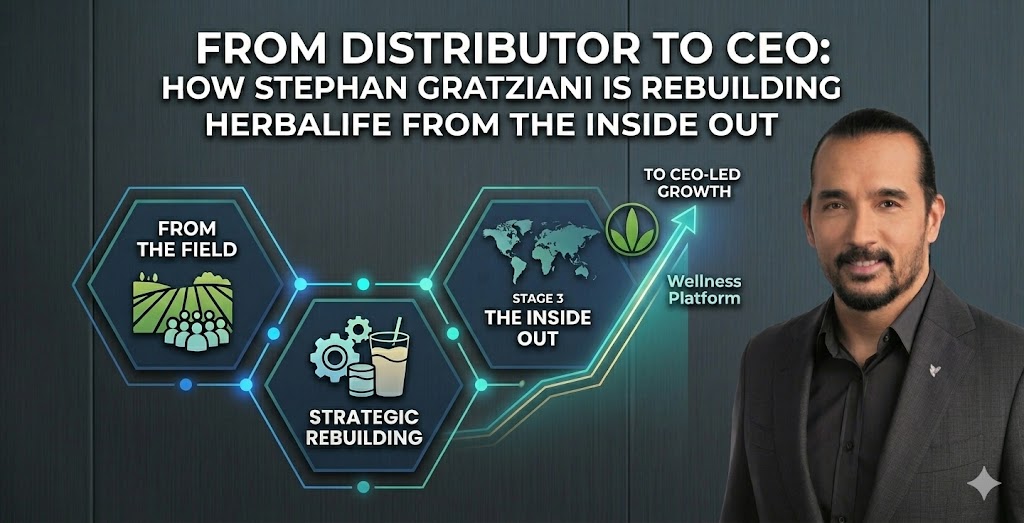
Stephan Gratziani did not come up through corporate ranks. He did not arrive from private equity or a rival consumer goods company. He started as a Herbalife distributor in Paris in 1991 at the age of 22, following a career as a competitive US cyclist. He built his distributorship across 70 markets over 32 years. He reached Chairman’s Club in 2010 and Founder’s Circle, the highest distributor level, in 2018. At the time he joined the corporate side of the business in 2023, he was one of the top three Herbalife distributors in the world.
That background matters enormously for understanding what Herbalife is attempting to do right now. The transformation the company is undergoing is not being led by someone who sees distributors as a distribution channel to be optimized. It is being led by someone who was one.
The Vision in Gratziani’s Own Words
When Gratziani was appointed CEO in May 2025, he described his vision with unusual directness. “Our scale and reach globally puts us in a unique position to become one of the world’s most important health and wellness platforms. Our belief in our business model and the value, service, and opportunity it provides is stronger than ever.”
That phrase, “most important health and wellness platforms,” is a different kind of statement than Herbalife has historically made about itself. The company has spent 45 years describing itself as a nutrition company. Gratziani is describing it as a platform.
The distinction is not just semantic. A product company sells a fixed catalog of items and grows by adding customers. A platform creates the infrastructure through which increasingly personalized, data-driven experiences are delivered, and the value compounds as more people use it. The acquisitions Herbalife has made under Gratziani’s direction make a lot more sense through that lens.
The Acquisition Strategy
In the twelve months since Gratziani became CEO, Herbalife has made three significant acquisitions, each one adding a different layer to the personalized wellness platform he is building.
Pro2col, acquired in April 2025, is a digital health and wellness application that uses individual biometric data to deliver personalized nutrition recommendations and tailored health protocols. Gratziani described the decision process candidly in a conversation with Pro2col President Blake Mallen and Pruvit CEO Brian Underwood: “Herbalife was already making plans to build a front-facing commercialized wellness platform and was investing heavily in infrastructure. As an entrepreneur, you have to jump; you have to move. You cannot wait.”
Link BioSciences, acquired simultaneously, is a Texas-based manufacturing company that uses proprietary technology to analyze biometrics, biomarkers, lifestyle data, and DNA. Its role is to take the data Pro2col collects and translate it into physical, personalized supplement formulas. Herbalife took a 51% controlling stake, giving it the ability to protect intellectual property while leveraging the technology.
Bioniq, the most recent acquisition announced in March 2026, adds a sophisticated biomarker database and a patented personalization engine that has already created tailored supplement formulas for hundreds of thousands of users globally. The acquisition is valued at up to $150 million and is expected to close in the second quarter of 2026.
Together, these three pieces form something that did not exist at Herbalife two years ago: a complete technology stack that can take individual health data, analyze it, and produce a personalized supplement formula specifically designed for that person’s biology.
What Pro2col Actually Does for Distributors
The part of this story most relevant to Herbalife’s distributor network is what the Pro2col platform does to the conversation a distributor has with a customer.
Under the traditional Herbalife model, a distributor recommends products from a catalog based on a customer’s stated goals, personal experience with the products, and relationship-based trust. That model has worked for 45 years. It is also, increasingly, competing against a world where consumers can access detailed health and nutrition data about themselves and expect recommendations to be calibrated to that data.
The Pro2col platform changes the conversation. A distributor working with Pro2col can walk a customer through a biometric assessment, generate personalized nutrition recommendations based on that customer’s individual data, and provide an AI-assisted health coaching experience that supports the customer’s ongoing health journey. The distributor becomes less of a catalog guide and more of a personal wellness coach backed by real data.
Gratziani described the broader vision: “For more than 45 years, Herbalife’s distributor network has supported millions of customers on their health journeys. Today, we are building on that legacy, combining science, data, AI, innovation, and community to bring the next generation of personalized nutrition and wellness to more people around the world.”
The Pro2col platform launched in beta in Q3 2025 with approximately 7,000 distributors and rolled out more broadly in the US in Q4 2025. International expansion into select EMEA markets is planned for 2026.
Cristiano Ronaldo’s Real Role Here
Cristiano Ronaldo’s involvement in Herbalife’s transformation has been covered primarily as a celebrity partnership story. The actual details are more interesting than that.
Ronaldo is a long-time Herbalife global nutrition partner. He is also a Bioniq shareholder, meaning he had an ownership stake in the company Herbalife just acquired. And in February 2026, he invested $7.5 million of his own money for a 10% equity stake in HBL Pro2col Software, the Herbalife subsidiary that holds the Pro2col technology.
That is three separate financial and commercial relationships with three components of Herbalife’s personalized wellness strategy. Ronaldo is not lending his name to a marketing campaign. He is a genuine stakeholder in the specific technology Herbalife is betting its future on, and his involvement predates the company’s acquisitions in multiple cases.
His statement on the Bioniq acquisition reflects that authentic connection: “Throughout my career, biometrics and personalized nutrition have been central to helping me perform and compete at the highest level. As a longtime Herbalife and Bioniq user, I’ve experienced firsthand how a tailored approach to nutrition can help optimize performance.”
For distributors, a spokesperson who is also a product user and a financial investor in the underlying technology is a meaningfully different and more credible story to tell than a standard celebrity endorsement.
The Bigger Context
Herbalife is not doing this transformation from a position of strength. The company has faced years of challenging revenue trends, distributor retention headwinds, and the ongoing obligations of an FTC consent order that fundamentally changed how it operates in the United States. Project Thrive, the company’s internal restructuring program, involved a 23% workforce reduction and $92.5 million in costs but is projected to generate $80 million in annual savings beginning in 2025.
The Herbalife One digital initiative, a multi-year investment valued at $400 million, is running in parallel, modernizing distributor tools, automating workflows, and building the digital infrastructure the personalized wellness platform requires.
So this is not a company with unlimited resources making bold bets from a comfortable position. It is a company that has concluded, under leadership that actually lived the distributor experience, that the path back to growth runs through a fundamentally different kind of value proposition to both distributors and customers.
The question that matters most for distributors considering whether to lean into the Pro2col and Bioniq opportunity is the same question it always is: does this make it easier or harder to have a compelling conversation with a customer who has never heard of Herbalife?
The data-driven, personalized wellness pitch is a better conversation than a catalog presentation. The technology is real, the investment is substantial, and the CEO leading it spent three decades on the same side of the table as the people who will be building businesses with it.
Whether the execution matches the vision is what the next two years will show.