4Life Research just published a clinical white paper with a title that sounds like it belongs in a medical journal: “Clinical Study on Rapid Modulating Effects of 4Life Transfer Factor Max on Immune Stem Cells.”
For most network marketing companies, publishing any peer-reviewed research is notable. For 4Life, it is consistent with a pattern of scientific investment that goes back more than two decades. The company describes itself as The Immune System Company and has backed that positioning with over 80 United States and international patents and a library of published studies. This latest white paper is the newest addition to that portfolio, and the results are worth understanding clearly.
What the Study Actually Found
The clinical trial was conducted at NIS Labs in Klamath Lake, Oregon. NIS Labs is an independent laboratory with a long track record of conducting human clinical studies on nutritional supplements and immune function. The fact that the study was conducted at an independent facility rather than in-house is relevant to its credibility.
The study followed a crossover design, which is considered a rigorous methodology for supplement research. Participants received either 4Life Transfer Factor Max or a placebo, then had their blood drawn three times over the following hours. One week later, the same participants returned and received the opposite of what they had been given in week one. This design means each participant served as their own control, reducing the influence of individual variation on the results.
The subjects were healthy adults who had never previously taken a transfer factor product. That selection criterion is significant because it eliminates the possibility that prior exposure to transfer factors influenced the results.
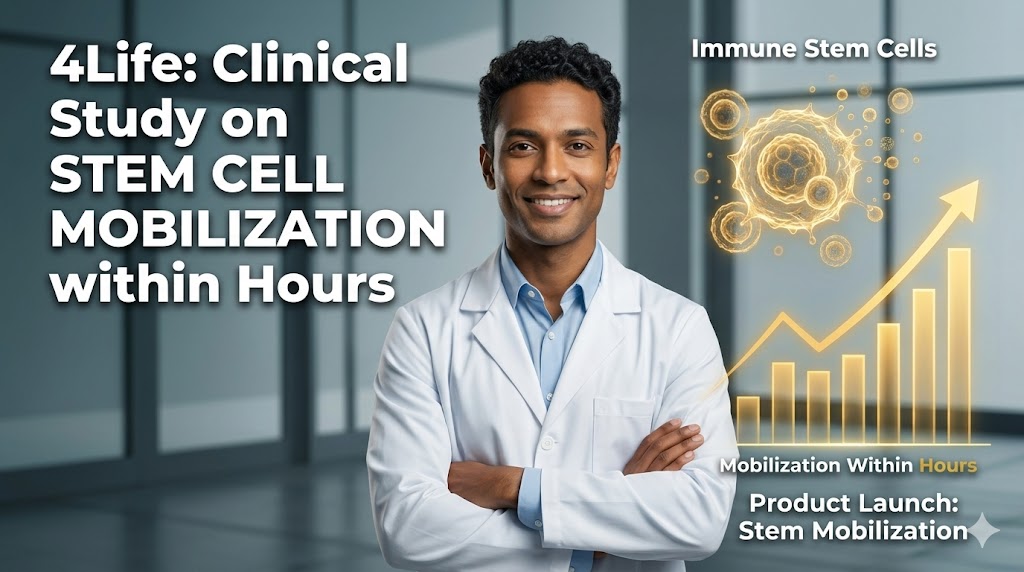
What the researchers found: within hours of consuming 4Life Transfer Factor Max, participants showed a notable increase in cell surface markers indicating cellular activation and stem cell mobilization into tissue.
Dr. Brent Vaughan, PhD, RD, Senior Vice President of Research and Development at 4Life, summarized it directly: “The results were quite positive. Within hours, those participants who consumed 4Life Transfer Factor Max experienced a notable increase in cell surface markers, indicating cellular activation and stem cell mobilization into the tissue.”
The company’s stated conclusion is that the product triggered short-term systematic immune system activity in healthy adults.
The standard FDA disclaimer applies: these statements have not been evaluated by the Food and Drug Administration and the product is not intended to diagnose, treat, cure, or prevent any disease.
What Makes Transfer Factor Max Different From Previous Products
4Life has been producing Transfer Factor products since its founding in 1998. The original formulation drew on bovine colostrum and chicken egg yolk as sources of immune peptides. What makes Transfer Factor Max the company’s most advanced product yet is the addition of PhytoFactor, a plant-based transfer factor 4Life’s research team discovered in 2014.
PhytoFactor comes from the seed of Brassica napus, the plant species that includes canola and rapeseed. The discovery that a plant source could yield peptides with transfer factor-like immune activity was significant enough that 4Life published two peer-reviewed articles in international scientific journals to document it: one in the journal Molecules and one in the International Journal of Applied Sciences. The discovery earned 4Life the 2025 Globee Award for Most Innovative Company of the Year.
The logic behind including a plant-based transfer factor alongside animal-based sources is that plants have a fundamentally different immune architecture than animals. Because plants cannot flee from threats, they developed what researchers describe as a “stand and defend” form of immunity. That distinct biological mechanism adds a different dimension of immune peptide activity to the formula.
Transfer Factor Max combines PhytoFactor with 4Life’s established Tri-Factor Formula from colostrum and egg yolk, a clinical dose of IP-6 (inositol hexaphosphate), vitamin C, vitamin D, and zinc. The stem cell study is one of two clinical trials 4Life is currently conducting on the product. The second study examines how the product affects neutrophil activity, a different component of the immune response.
Why Immune Stem Cells Matter
The specific finding, stem cell mobilization, is worth explaining in plain terms because it is the most clinically interesting aspect of the white paper.
Immune stem cells originate in bone marrow and circulate in the bloodstream. When the body perceives a threat or a need for immune response, these cells are mobilized from the blood into tissue where repair and immune activity are needed. The clinical observation that Transfer Factor Max appeared to trigger this mobilization within hours, as measured by cell surface markers in blood draws, suggests the product was prompting the immune system to shift into an active surveillance mode.
This is a biomarker finding, not a clinical outcome. The study measured indicators of immune activity, not the resolution of a specific illness or condition. That distinction is important to maintain when discussing the research accurately. What the white paper demonstrates is a measurable biological response, which is a meaningful and scientifically documented step beyond simply claiming a product “supports immune health.”
What This Means for Distributors
4Life has been building toward this product for over a decade. The original discovery of PhytoFactor happened in 2014. The peer-reviewed publications came after years of research. The clinical trials are now producing results. Transfer Factor Max launched in April 2026.
For 4Life distributors, the clinical white paper represents something valuable that many products in the network marketing space cannot offer: documented, independently conducted evidence of a measurable biological response, published by the company with full methodology and researcher attribution.
The immune supplement market is crowded. Competing on product claims alone is increasingly difficult when consumers can search for any claim online and find contradictory information. A placebo-controlled crossover clinical trial conducted at an independent lab and published as a formal white paper is a different kind of story to tell than a testimonial about feeling better.
That does not mean every customer conversation needs to become a science lecture. It means that for the distributor talking to a prospect who asks whether the products have any science behind them, the answer is not just “yes.” It is a detailed, documented, specific yes.
4Life has been building that answer since 1998. The Transfer Factor Max white paper is the latest addition to a scientific portfolio that few direct selling companies can match.