Mary Kay has been in business since 1963. For most of those six decades, the business model looked the same: a Beauty Consultant builds relationships, hosts parties, and sells product person to person.
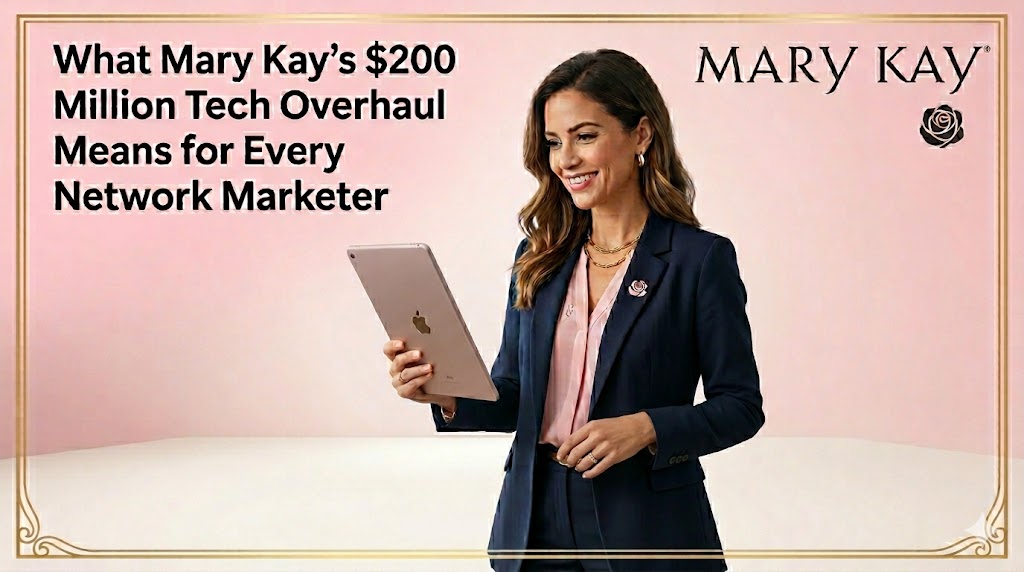
That model still works. But what the company just quietly described to the technology press is one of the most aggressive infrastructure overhauls in direct selling history, and it has specific implications for anyone building a network marketing business in 2026.
James Whatley, Mary Kay’s Chief Information Officer and a 27-year company veteran, just gave a detailed interview about what the company has been building. It is worth reading carefully.
What Mary Kay Actually Built
The scope of what Whatley describes is significant. Over the past several years, Mary Kay closed five data centers worldwide and moved over 95% of its custom applications to cloud-based SaaS platforms. That includes everything from eCommerce to supply chain to the global Enterprise Resource Planning systems that run the entire business.
For context, that kind of complete tech stack replacement is, as Whatley put it, “unprecedented for a global company of our size.” Most companies of similar scale migrate piece by piece over many years precisely because the risk of doing it all at once is enormous. Mary Kay did it in what Whatley called “record time.”
The centerpiece of the transformation is the new Consumer to IBC Commerce solution, which creates personal online commerce shops for each Beauty Consultant. This launched in Germany and the United States in 2025 and is rolling out globally in 2026 to more than 25 countries. Every Beauty Consultant who uses it becomes a fully functional online retailer with their own branded storefront.
The AI Layer
The technology infrastructure is the foundation. The AI tools built on top of it are where the story gets interesting for distributors in any company.
Mary Kay has deployed three consumer-facing AI tools that are worth understanding because they represent a specific philosophy about how technology should support a relationship-based sales model.
The AI Foundation Finder scans a customer’s face on their mobile phone and identifies personalized foundation shade recommendations in seconds, detecting 151 individual facial feature points. Mary Kay describes this as a first in the direct selling industry. A Beauty Consultant who 10 years ago had to guess at a shade match based on experience and judgment can now hand a customer her phone and deliver a clinically precise recommendation in moments.
Mirror Me is an augmented reality real-time makeover app that supports virtual try-on, letting customers see products on their own face before purchasing. The Mary Kay Skin Analyzer App adds another layer of personalization, assessing skin condition and recommending products accordingly.
What ties these tools together is a principle Whatley stated explicitly: “You’ve got to start with the customer experience and work backwards to the technology.” These are not technology projects that happened to find a use case. They are customer experience problems that were solved with technology.
The Question Every MLM Company Is Being Asked
Whatley was asked directly whether leveraging AI and eCommerce is actually compatible with a relationship-based business model. His answer is worth quoting.
“100% compatible. Our obsession is ‘How do we continue to deliver a world-class opportunity to our Independent Beauty Consultants around the world?’ Consumer expectations shift toward seamless, on-demand, and transparent buying journeys. Digital tools enable her to engage customers where they already are, across social, mobile, and e-commerce channels.”
He cited a specific number: mobile commerce now accounts for over 62% of beauty sales in key markets. That means the majority of the transaction activity in the industry Mary Kay operates in is happening on a phone. A company that had not rebuilt its technology infrastructure to support that reality would be losing sales every single day.
The question is not whether AI and eCommerce are compatible with the relationship model. The question is whether your company has built the technology to support the relationship model where customers actually are.
What This Means for Network Marketing Broadly
The Mary Kay story is interesting in isolation. In context, it is part of a pattern worth paying attention to.
Herbalife has spent over $200 million acquiring personalized nutrition technology. Zinzino has spent 14 years building a blood test and biomarker database that proves its products work. Now Mary Kay has rebuilt its entire technology infrastructure and deployed AI tools that give Beauty Consultants capabilities that would have been impossible five years ago.
The message across all three of these moves is the same: the companies investing heavily in technology are not trying to replace their distributors. They are trying to make their distributors dramatically more effective.
A Mary Kay Beauty Consultant in 2026 can open a personalized online storefront, scan a customer’s face for a precise foundation match, show that customer a real-time virtual try-on of any product, and complete the transaction on a mobile device without any of those activities requiring manual steps or guesswork. The relationship is still the point. The technology removes the friction.
That is the version of network marketing that wins going forward.
The Part Most People Overlook
There is one line in Whatley’s interview that deserves more attention than it typically gets in technology discussions.
“Technology alone does not drive change, people do.”
Whatley described Mary Kay’s digital acceleration as being powered by a “One Team Mindset.” He talked about treating internal teams, market partners, vendors, and customers as stakeholders in the transformation process, not end-users. He described culture as a multiplier. He talked about the AI Committee the company formed to govern AI adoption, ensuring every implementation has proven ROI and aligns with the company’s values.
This is the CIO of a company that just closed five data centers and rebuilt its entire global infrastructure from the ground up, and his main insight is that the technology worked because the culture was right first.
That is not a technology lesson. That is a network marketing lesson.
The best tools in the world are only as valuable as the people who use them and the culture that supports their adoption. A company can hand its field force an AI foundation scanner and a personal eCommerce storefront, and if the training, the community, and the mindset are not there to support it, the tools sit unused.
Mary Kay has been building its culture since 1963. The technology is new. The foundation it is built on is not.
The Bottom Line for Distributors
If you are building a business in the health, beauty, or wellness space through network marketing in 2026, the question to ask your company is the same one Mary Kay spent years answering for itself.
Does my company’s technology make it easier or harder for me to meet my customers where they actually are? Does the technology I have access to make me more effective, or does it require my customer to come to me on my terms?
Mary Kay’s answer, after closing five data centers and rebuilding from scratch, is a personal online storefront, an AI-powered face scanner, augmented reality try-on, and skin analysis in the customer’s hand, available any time, anywhere.
That is a high bar. It is also the direction the whole industry is moving.