

Seen a headline saying almost everyone fails in network marketing? Maybe you joined for the discount, and now a number says you failed.
I’ve been in network marketing for 30+ years and writing about it here since 2003.
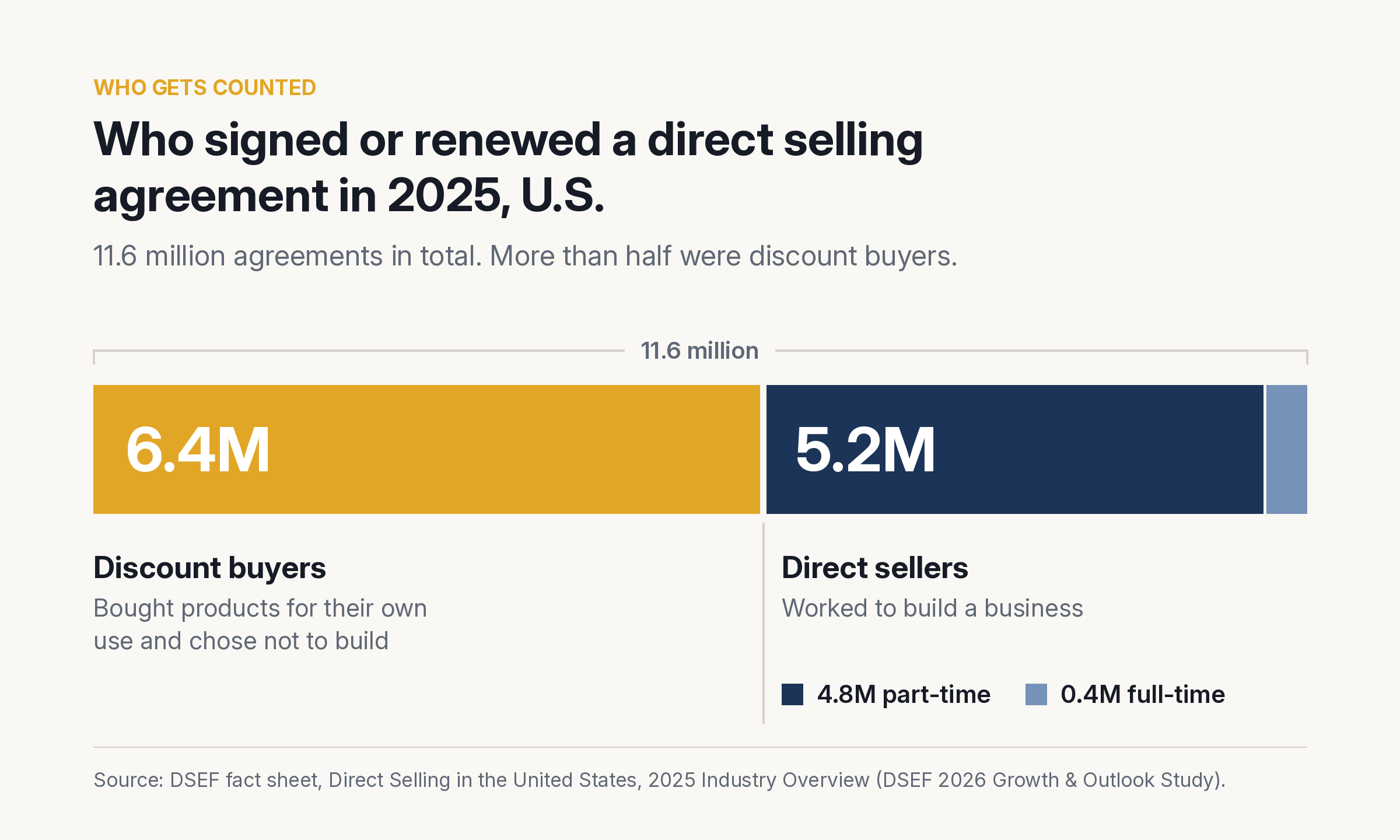
In 2025, according to the DSEF fact sheet, 11.6 million people in the U.S. signed or renewed agreements with direct selling companies, and 6.4 million were discount buyers who bought for their own use and chose not to build. They didn’t fail. They went shopping. In my experience, very few reports account for them, and that makes network marketing look worse than it is for builders. The FTC knows they’re there. It counts them as participants, and I think that’s the wrong bucket.
That doesn’t tell you what a builder earns. It tells you the number you’re looking at isn’t only about builders, so go find the part that is.
What is the MLM failure rate, really?
There isn’t one official MLM failure rate. No government agency publishes one, and different studies count different people. A 2024 FTC staff review of 70 income disclosures measured how much participants were paid, not who failed. It found that many received no payments, and that in most of the companies where staff could do the math, the large majority received $1,000 or less a year, before expenses. You can read the full report.
The reasons people struggle are a separate question, and I cover them in why most people fail in network marketing. Here, the question is simpler: who’s actually in that count? A number for what people were paid doesn’t tell you much until you know.
How many MLM distributors are really customers?
By the industry’s own count, more than half. The DSEF fact sheet for 2025, published in 2026, says 11.6 million people in the U.S. signed or renewed independent contractor sales agreements with direct selling companies. Of those, 5.2 million were direct sellers who built a business, most of them part-time. The other 6.4 million were discount buyers who “purchased products for their own use but chose not to build a business.”
DSEF describes discount buyers as “product lovers, only purchasing products /services they personally enjoy and use at a discount.” It even counts them with its customers, in one box of 34.8 million preferred customers and discount buyers.
That lines up with what I’ve seen. A lot of people sign up as a distributor mainly for the discount on products, and they have no desire to build a business.
Not every study agrees. An AARP Foundation survey of people who had worked as distributors found 43% listed buying products as one reason they joined, though only 9% said it was their only reason. A survey of reasons and a count of agreements measure different things.
If more than half the people signing up are really shoppers, you’d think the averages would sort them out. Mostly, they don’t.
Why the numbers make network marketing look worse than it is for builders
In my experience, very few FTC reports and company income disclosures account for discount buyers, the people who sign up for the product discount and never try to build. Count them as distributors, and the picture for people who actually build looks gloomier than it really is.
The FTC knows they’re there. When its staff counted 14.6 million participants for 2022, that number came from the industry’s own figure, and it included 7.9 million discount buyers. In a footnote, FTC staff questioned why people who signed up as participants, not preferred customers, should be called discount buyers instead of participants. It counts them as participants, and I think that’s the wrong bucket.
An average adds everyone together. If a big share of the people counted never tried to build, the average says a lot about shoppers. In one example, FTC staff counted a company’s discount buyer group, 72.5% of its participants, among people receiving $1,000 or less. That makes sense. Shoppers likely received little or nothing. Other disclosures say their zero earners were just customers, but FTC staff found none of them explained how they knew.
To be fair, plenty of disclosures leave out people who earned nothing or call them “inactive,” and FTC staff guidance says that’s misleading. Under that guidance, someone should only be left out when the company “has evidence that they have affirmatively opted out of the income-earning opportunity.” Leaving people out isn’t the same as showing you who signed up to shop. That’s the split I’d like to see.
Economists at Edgeworth Economics, writing in DSEF’s Journal of Direct Selling Research in 2025, saw both sides. They noted that every company has some participants who signed up just for a discount, and that including them “deflates the typical earnings across all distributors.” But “excluding such distributors risks allegations that the IDS artificially inflates earnings by including only those distributors who have achieved some degree of success.” Showing everyone, then sorting them, answers both.
They called it some. DSEF’s own numbers say it’s more than half: of the 11.6 million agreements signed or renewed in the U.S. in 2025, 6.4 million were discount buyers.
There’s good and bad in network marketing, in the companies and in the numbers. And sometimes the good is hiding in the column nobody writes about: the person who just loves the product.
Is it okay to join a network marketing company just for the discount?
Yes. That person isn’t a failure. That’s a customer. If you love a product and want a better price, that’s a perfectly good reason to sign up. Good companies are built on customers. If that person shares it with a handful of friends, they may be able to offset some of their own product costs. That’s not a bad thing at all, and it’s completely overlooked by critics who suggest everyone wants to get rich in network marketing. Those critics often take their experience from a handful of the largest companies, the ones that operate on the opportunity-first model.
Picture someone who signs up as a distributor only for the price on a product she loves. She reorders it every month and never wanted to build. But every time a failure number goes around, she’s in it. Once you see that, the number stops being about her.
I’ve seen the other path too. Some people sign up intending to build a business, then end up staying because they love the product discount. They’re not failures. They became customers.
A lot of this starts with the sign-up conversation:
| Instead of this | Try this |
|---|---|
| “If you’re going to sign up, you should really build something. If you don’t, you’ve failed.” | “Sign up whichever way gets you the best price on what you love. There’s no requirement to build. If you end up sharing it with a friend or two, great.” |
Most of us have said some version of the first one. I don’t try to talk anyone into anything. I ask questions until I know whether what I have is a solution for them. Many companies offer the biggest discount to distributors, so that’s a natural choice for someone who loves the product. A customer option doesn’t necessarily fit them better. There’s no requirement to build a business, and sharing the product with someone is viable. The accounting that lumps discount buyers in with builders isn’t the distributor’s job. That’s on the company, and on outside forces, the FTC, the critics, and how the disclosures count people. Get the best product discount, and if you’re inclined at some point, share it. There’s more on serving customers and distributors here on the blog.
That’s also why I think the biggest problem in network marketing is people starting with the opportunity instead of a product they truly love, one that makes an impact on their life. A product-driven opportunity is better than an opportunity-driven opportunity.
Network marketing products are generally of high quality. I can’t think of many times I’ve looked at one and said, I don’t know why someone would use this. But many times people join and use the product because they think it’s going to get them a level of income. Then when they leave, they stop using it. They weren’t customers. The discount buyer stays because she likes what she buys.
If you do want to build, the same habit helps. Start with the product, then read the numbers.
How do you read the numbers if you want to build?
Here’s where I’d look, in order.
- Ask who’s counted. Everyone who signed up? Only people who got paid? Only “active” people? Where are the discount buyers?
- Look for a disclosure that leaves nobody out. It should include the people who earned nothing, then separate the people who chose a customer path from the people who tried to build. That’s rare. In the FTC’s review, only five of the 70 showed everyone and then a separate breakdown for “active” participants. My guide on how to read an MLM income disclosure goes line by line.
- Ask what the work looked like. When someone says people worked so many hours a week, what does that mean? Conversations with potential customers, meetings that never brought in a customer, or training meetings with ulterior motives, like making money for the people who put on the meeting?
- Ask about yourself and the person teaching you. Are you doing the work? Are they using strategies that work today? A lot of people learn from someone still running a 1995 playbook.
- Remember that disclosures show money paid, not expenses. Do your own math on what you’d spend.
A good disclosure is one the newest person on a team can read and understand. And remember, income is really based on significant effort.
Put all that together, and the scary number starts to look useful. A customer reorders what she enjoys and never feels like a failure. A builder picks a product he believes in, reads the disclosure the way you just learned, and has someone teaching him what works now. That’s network marketing at its best.
If you decide to build, your story is what helps people find you. I trained as a StoryBrand Guide, and that training is behind the template I share. If you’d like help telling your story in your own words, my free Facts Tell, Stories Sell template is the place to start. It comes with an AI prompt to help you draft it.
Frequently asked questions
What is the real MLM failure rate?
There’s no single official number. It depends on who gets counted and what “fail” means. Many headline numbers include everyone who signed up as a distributor, discount buyers too. I believe very few of those reports account for those shoppers, and that makes network marketing look worse than it is for people who actually build.
How many MLM distributors are really customers?
More than half, by DSEF’s count. Its 2025 fact sheet says 11.6 million people in the U.S. signed or renewed independent contractor sales agreements with direct selling companies. Of those, 6.4 million were discount buyers who purchased products for their own use and chose not to build a business.
What is a discount buyer in network marketing?
A discount buyer signed an agreement with a direct selling company but only buys the products they enjoy, at a discount. DSEF calls them “product lovers.” They’re allowed to sell and bring in others, and they choose not to. That’s a customer, and a happy customer is one of the best things a company can have.
Do income disclosures count discount buyers?
Usually they’re in there, but I think very few account for them so you can see them. Look for a disclosure that shows everyone, including the people who earned nothing, then sorts them.
Is it okay to join a network marketing company just for the discount?
Yes. If you love a product and want a better price, that’s a fine reason to sign up. Sign up whichever way gets you the best price. There’s no requirement to build. You’re not a failure for buying what you enjoy. You’re a customer, and that’s normal.
If I want to build, how should I read the numbers?
Start by asking who’s counted. Find the figures for people who tried to build, and make sure the people who earned nothing are still shown. Then ask what the work looked like, and whether the person teaching you uses strategies that work today.
About the author
Ty Tribble has spent 30+ years in network marketing and has been building his business online since 2003. In 2003 he launched MLMBlog.net, the first blog about the network marketing industry as a whole. He created the A.C.E. Strategy and the Facts Tell, Stories Sell template, and wrote The Online Downline and Double Your Income with Network Marketing (Wiley, 2012).


